Monday, August 13, 2012

Manuel Antonio National Park

Saturday, August 11, 2012

Kesa, Melissa, and I left by bus for Manuel Antonio at 6:00 this morning. The ride was supposed to be 3 to 3-1/2 hours long. The bus stopped in Quepos (although we didn´t know it at the time) around 9:30 so we knew we were close. However, there were no announcements or signs, so as usual, we looked around for some kind of hint as to whether we were supposed to get off or not. Very few people got off, so we assumed we were not at Manuel Antonio yet. I still can´t believe we didn´t ask; we just ASSUMED and stayed on the bus. About 10-12 minutes later, the bus made a final stop right beside a beautiful white sand beach:


We all got off the bus and the 3 of us stood there looking at each other like, ¨Now, what?¨ At 10:00 in the morning the weather was already stifling hot and humid. A few people were on the beach and there were some markets and restaurants on the other side of the road with a few street vendors roaming around.

We asked a man who was setting up his fruit cart for directions to the hotel Flor Blanca where we had reservations. He asked a woman to help us and she told us the ¨taxi¨ would take us back up the hill to the hotel. She took us to an old blue car, said a few words to the driver, which I couldn't hear, and gave him a knowing look and smile. I didn´t have a good feeling getting into an unmarked car. We had been warned that official taxis are red with a yellow triangles on the side doors. This car was not red, nor did it have taxi markings. We had no sooner sat down in the cab, than I immediately grabbed my bag and said, "Ï´m getting off. Please open the trunk so I can get my suitcase.¨  Melissa and Kesa looked at me like I was nuts and asked me what was wrong as they reluctantly got out. I explained my concerns while the so-called taxi driver was waiving paperwork at us indicating he was licensed. Sorry...no red car with yellow triangles, no ride for me...

Soon a real taxi came along and we hopped in. I asked the driver to turn on the meter, but he said it was a flat rate of $6.00 for the three of us. Another red flag: we were also told not to allow flat rates. However, this time I didn´t want to be the one to speak up and really look like a wierdo, so I kept my mouth shut and we split the cost of the $6.00 ride three ways.

After checking into the hotel and enjoying 10 minutes of air conditioning, we decided to head to the Manuel Antonio National Park and save the beach for the next day. We caught another bus back down the hill to the same beach we just came from, got off, crossed the road and walked through what can best be described as an alley lined with one souvenier tent after another. I couldn't believe this muddy alley was the way to get to the park entrance, but it was! We walked quite a ways,  listened to vendors calling for our business, and tried to figure out just where the park was located. After several twists and turns down the muddy path and eventually past a residential area, we came to a little street crawling with people trying to get us to pay them for a 2-hour guided tour through the national park with guarantees of seeing monkeys and sloths. We decided not to pay for a guided tour and had to go to the bank to buy tickets into the park.

Entrance to the park


As we entered the park, we saw a white tail deer grazing at the entrance:


There were trails throughout the park leading to the Manuel Antonio beach as well as several other beaches in the area. As we walked, we could hear that the forest was alive with insects. We could hear their noises so loudly it was as if someone had set up microphones throughout! Along the way, we saw crabs in the forest along the side of the road. I was surprised to see crabs so far from the beach. They live in holes in the mud.


Crab along the side of the road.


The flowers along the trail were lovely. They are called heliconias and were everywhere:


Lots of insects, too:


Stick bug.It was about 10 inches long.


Spider web.

We could hear birds all around us, but this is the only one we saw:


We kept looking for monkeys and sloths and asked people returning along the trail if they had seen any. One person after another assured us there were monkeys, sloths, and iguanas at the beach which kept us motivated as we walked in the insufferable heat.

Eventually, we came to the beach, still not having seen any monkeys or sloths.


One person after another told us about the monkeys they had seen. They would come in droves and then disappear. Unfortunately, they were gone when we were there. We looked and looked but never found them, but we did see a cute video that a man from New Jersey shared with us. It showed the monkeys fighting over some garbage they found. One took a juice bottle up in the trees and was trying to take a big drink out of the bottle.

We did see a mapache (like a raccoon):


And several black iguanas:


The Manuel Antonio National Park is interesting and the beaches beautiful. I recommend an early start to avoid the heat and humidity of the afternoon and a better chance at seeing the monkeys. It sounds like they were out and about earlier in the day.

Friday, August 10, 2012

Things that Rhyme with Coyote

Wednesday, August 8, 2012

I will admit right upfront that I am a naive American. I guess I also have to admit that unwittingly, and certainly with no arrogance intended, I thought the center of the universe was the United States...or better said, the world revolved around the United States. What I'm getting at is that I thought every fruit and vegetable known to mankind could be bought in the United States. I honestly, truly, naively thought that all those beautiful exotic fruits (kiwi, mangos, papayas, and pineapple) and vegetables (yucca, bok choy, and cilantro) found in the U.S. supermarkets were all that existed in the world.

And then I came to Costa Rica.

So far, I've seen very few fruits and vegetables that I would see in the U.S. (just tomatoes, onions, carrots, potatoes and bananas). What I have seen are many, many others that are so unusual in name, texture and taste, that I really feel like I'm in some other world.

Let's start with the things that rhyme with coyote. There are zapotes, elotes (corn on the cob), camotes (tastes like sweet potato), chayotes, and jocotes. I can't say I've had zapotes, but elotes are good dripping in butter (American-style). I had camotes mixed with plaintains, yams and potatoes with roast beef and they were good. Peeled chayotes sort of look like a peeled green apple, but have no flavor and few calories...I guess they must have some nutrients else why would we eat them? And jocotes...well they are really different. I bought a bag on the street the other day. I was practically mugged when I went in the school (only a slight exaggeration.)They are that popular! They are about the size of an Italian prune with a large pit in the middle. They dip the green ones in salt. The red ones are sweeter, ripe and juicy. I didn't really care for the taste or the texture. It was almost like they were both juicy and powdery inside.

There is also yuca, not to be confused with yucca. It, too, is a root that is really not a fruit or vegetable, but is apparently not the same root as  yucca. It is potato-like and delicious cooked with other vegetables and meat. KFC has both french fries and yuca fries, depending on your preferences. They also offer biscuits like in the states, but corn tortillas if you prefer those.

Oranges and mandarins are green here, not orange. I don't know why. A few guys have a shopping cart filled with them on the street outside the school and will fresh squeeze juice for you if you want to start your day with a little Vitamin C.

Platanos (plaintains) are very popular. Maduros are made from the ripe ones, fried or baked---very delicious. Patacones are made from the green ones, sliced, fried in oil and salted. Also very delicious.

Pejibaye is a palm tree fruit, cooked and eaten with mayonnaise.

The most unusual fruit I've ever seen is the mamon chino. It is a small red fruit with long soft spines or spikes. It kind of looks like a cross between a sea urchin and a koosh ball. They are supposed to taste good, but I can't get up the nerve to try it. Take a look and see what you think:
http://www.cupotico.com/info/General/Mamones.html

Buen provecho!

Thursday, August 9, 2012

Artistic Expressions

Wednesday, August 8, 2012

I had a couple of hours between classes today and walked to downtown San Jose with a friend, Debbra, who is from northern California. It only takes about 30 minutes to walk there and there was a pleasant breeze--a much welcome relief after a humid morning.

Right before getting to the center of town, there is a wall that is painted with all kinds of "public art."  Here are a few samples:

The wall is probably 60' long and covered with all kinds of art.

Same wall as previous picture

Same wall

There is also a lot of graffit all over the city. Any building not in use has been tagged at least once:


When we got closer to town, there was a crowd of not-so-happy people outside the legislative assembly building and several police officers keeping an eye on them. I'm not sure what they were protesting, but the gate was locked to them. They would occasionally shout out their grumblings. It was not by any stretch of the imagination dangerous or out of control, just a gathering of people anxious to express their opinion to the legislature. Next to the building scrawled on the wall, someone wrote. "The docks/spring (the word muelle means both things) belong to the town."  Another read, "Down with the PLN." (a political party)
As usual, as we approached downtown, the streets were filled with people and street vendors as far as the eye could see.

In a park we saw a mime and a VannaWhite-like-girl holding a sign to get people to drop coins in the mime's hat for each move he would make:

Everyone is looking for a way to make a buck...er, I guess that would be a colon.


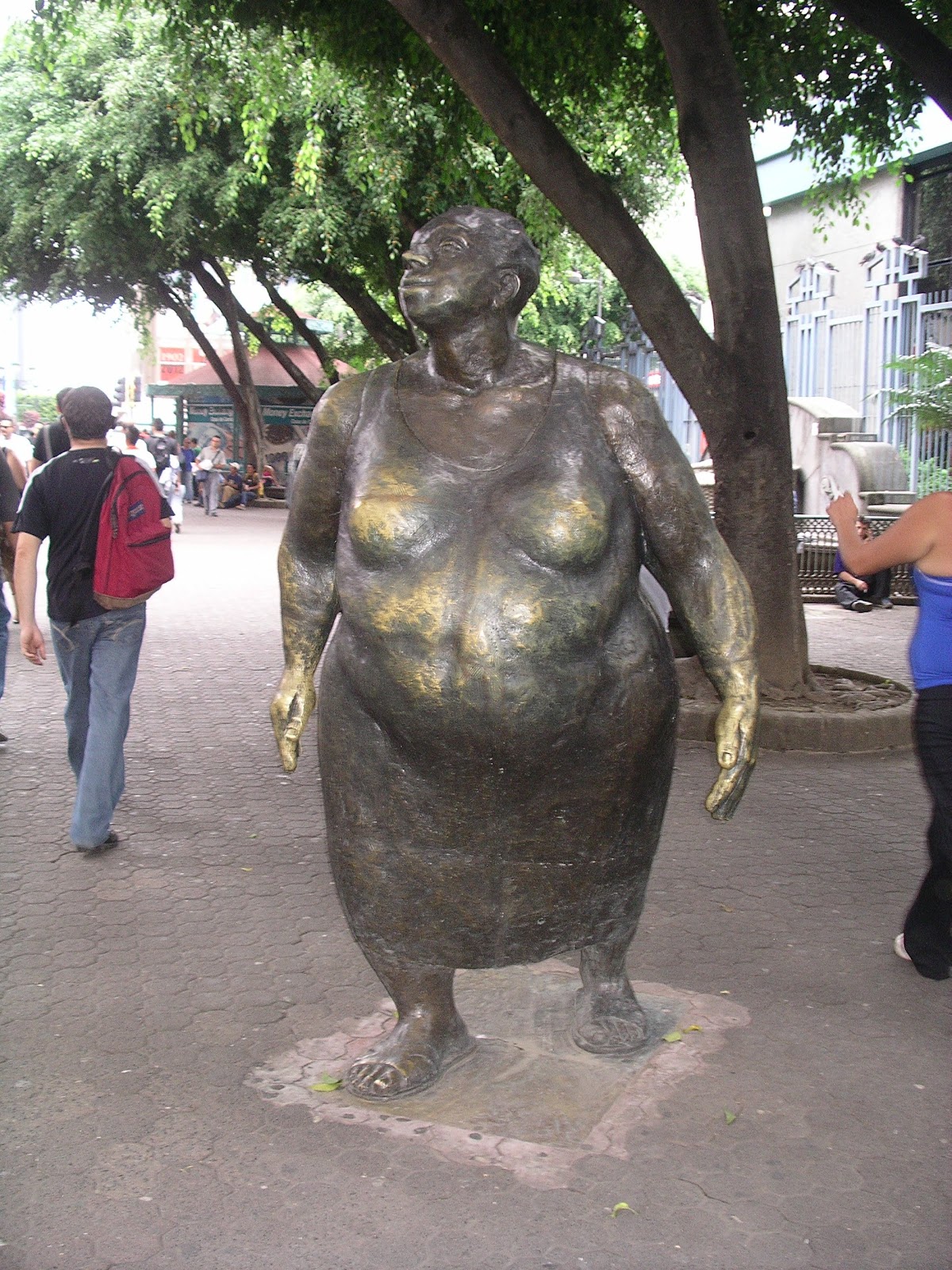
And we saw the most curious statue. I'm not sure of its purpose:


Big Mama comes to San Jose.


Finally, we ended up at the Mercado Central (Central Market). Think of  movies you've seen that take place in foreign countries and there is a market scene. That would be the Central Market. The place was huge with row after row of stalls that sold everything from meat, to flowers, nuts, spices, coffee, fresh fruits and vegetables, traditional and modern clothing, jewelry, pets and pet supplies, small cafes, just about anything you can think of. Everything was crowded together with people trying to get you to stop at their place and buy. I didn't buy anything, but I sure had a good time checking it all out.

As we turned to go back to the school, we made one last stop at the National Theater so Debbra could buy symphony tickets. My jaw dropped when we went inside. It is a very classically decorated theater:

Foyer of the National Theater
 

 Bus Update
I didn't think the bus ride home could top the one last week, but each day seems to get more frustrating.
Yesterday, after waiting for an extraordinary amount of time, I saw a bus that said, "Santa Marta," but didn't pay attention to the fact that it also had 10 other places listed. Apparently, it brushes by one little corner of Santa Marta and makes a sneaky left turn, which caught me by surprise and also took me away from where I wanted to be. I panicked and got off the bus as soon as I could. I ended up with a 30 minute walk home...

Today, it was dumping rain, but I was determined to wait for THE bus to Santa Marta. I waited over 40 minutes when one finally came along...it was full with no room for one more thing. I waited, waited, waited... Finally a bus to Granadilla came along. Granadilla is the town after Santa Marta, so I figured I would just get off in Santa Marta. I got on. The bus was full, but a nice young man motioned for me to take his seat. The bus was completely and totally filled with people. The seats of course, were full, but the aisle was 2 to 3 people deep from front to back of the bus. The driver kept picking up more and more people. I'm not sure where he put them all, but I was squeezed next to a window unable to see anything because of the dark and the soggy, steamy glass. A few nice people around me who were standing and could see better, kept an eye on our location and pulled the bell advising the bus driver that someone wanted to get off at the appropriate time. Getting off the bus was an interesting logistical task, but I eventually made it off.

Sana y salva.


Wednesday, August 8, 2012

Where's the beef?

Wednesday, August 8, 2012

You may remember the old Wendy's commercial with the irritated old woman demanding to know "WHERE'S THE BEEF?" Well, I can relate! My fat cells were protesting yesterday. "We haven't had spaghetti with garlic bread and a tossed salad in a long time. Barbecued chicken and corn on the cob would be good. Even a Subway sandwich and chips would go a long way towards appeasing us. We need something that doesn't look, sound, or taste like beans and rice."

Answer: KFC to the rescue. At lunch time today, I went to San Pedro Mall and ordered a Chicky Pack, not realizing it was a kids meal, but it hit the spot, anyway. (And I got a very cool Alvin and the Chipmunks watch that really works!) One greasy, fried chicken sandwich, some crispy, greasy french fries with ketchup, a glass of Mug rootbeer and I was transformed! After classes I went to Pops for a scoop of chocolate ice cream. I am once again in harmony with the universe. All is well. Ahhh...

During the weekly cooking class today, we made Picadillo de papa y chayote. It has beef in it!
I FINALLY FOUND THE BEEF!

Ingredientes:
1 chile grande (big, red)
1 cebolla grande (large chopped onion)
Culantro (cilantro)
3 thingies of ajo (garlic) -- I can't remember what the chunks you break off are called.
6 chayotes (vegetable that rhymes with cayote) No flavor or calories, so I'm not sure of it's purpose...
1 lata of maiz dulce (a can of corn)
Medio de kilo de papas (1/2 kilo of potatoes)
1 kilo de carne molida (1 kilo of ground beef)
Achiote (another vegetable, used for coloring)
Sal (salt)
Salsa de tomate (tomato sauce)

Preparacion:

Cook the pealed potatoes in salted water. Let them cool while you are peeling and chopping the chayotes. Cook the chayotes in a frying pan in some water until almost tender. Add some oil to a frying pan, fry the onions, chile dulce, garlic and ground meat together. Add the chayote to the meat mixture and cook for 20 minutes. Then add the potatoes and let it cook for another 15 minutes. Mix in salsa de tomate, el maiz dulce and cilantro (Yuck! If desired.) Serve with warm corn tortillas.

Culinary Review:
5 thumbs up. Tasty, hearty, filling. I will definitely make this again.


Gather the ingredients


Chop all the vegetables


Fry the meat and vegetables


Serve it in a small corn tortilla
Buen provecho!

Tuesday, August 7, 2012

Say what?!

Tuesday, August 7, 2012

The following signs made me feel a lot better about my struggles with learning Spanish. I've been taking these pictures as I see them about town:

Warning about sneaking guests into your hotel room without paying for them.

Translation: Please don't use the white towels to clean the floor or your shoes.

Self-explanatory: old pipes, don't flush toilet paper.


As funny as these are, I have to acknowledge that it is very likely that any of us learning Spanish most likely sound just like this when we are speaking in Spanish.

At school today, we had to give a 10-15 minute speech about some aspect of Costa Rica, such as it's history, culture, or geography. We were given the assignment 2 weeks ago, but I ended up putting it together last night. I just couldn't get excited about having to choose a topic, do the research and put together a speech. I changed my topic 4 times over the past 2 weeks and finally settled on El dia de las madres (Mother's Day) in Costa Rica which happens next week. The talk went ok, but I am glad it is over! Marcia and Jenny made a poster for me to use with my talk. I thought that was very nice of them:


It says, "Mother's Day.  Mothers...It's not important how much we grow up, they always love as like we were little."


It was very humid today. After lunch, the sky darkened and we had quite a downpour which lasted for several hours. It cooled right down, cleared out the steamy humidity and felt great. I found out today how the humidity cycle works around here. First it rains alot. Then the sun comes out and as it dries out the ground and warms everything, the steamy water vapor rises and it feels sticky humid. This ends up in the clouds, which fill up and start the process all over again.

More later...

Monday, August 6, 2012

Do you know the way to San Jose?

Monday, August 6, 2012

"Do you know the way to San Jose? I´ve been away so long, I may lose my way..." So goes the song by Dionne Warwick. I couldn't resist using this title to talk about how to get around San Jose without losing one's way.

The most common way is to take el bus. The bus system seems to be very good. There are plenty of buses and they run regularly. No one seems to be very concerned with bus schedules. They just go to the bus stop and wait. One will come along soon. I have only had to wait a half hour twice; usually a bus comes within 10 minutes or so. To let the bus driver know you would like him to stop for you, put your arm straight out to your side, at a 90 degree angle to your body, about shoulder level or slightly lower, pinch your fingers and thumb together as if you are trying to hold something really tiny, and motion your hand up and down much like your head when you want to say "yes". Do not put your hand up in the air as if to wave or flag down the bus like we do in the U.S. The bus driver and passengers will wave back as they drive by, leaving you still standing at the bus stop!

The driver is called el chofer and a person se sube (gets on the bus), pays the tarrifa (210 colones), and se baja (gets off the bus). There are no bus transfers, so if you get off the bus to run an errand, you pay full price to get on the bus again. If you want to change buses in town to go in another direction, you also will pay full price again. NO TRANSFERS.

If you are lucky, el chofer will not kill you getting you to your desired destination. I´ve already spoken of a few of the mishaps I´ve experienced on a bus, but let me add one more anecdote.My ride to school today was absolutely the worst ever. The driver seemed to be a little pithed to say the least. He was very aggressive, stopping on a dime just in time to avoid a little car in front of us that would not let him get in the long line of traffic heading to town this morning. He swerved around another bus into oncoming traffic and stopped underneath a red light. At least he stopped; it sure didn´t look like he was going to. Then there was a near-miss with a bicyclist pedaling down the middle of the road during rush hour followed by another serve and fast stop to avoid hitting another bus.All of this swerving was occuring while he was chatting with a passenger behind him. I said "gracias" to the chofer as I always do when I get off the bus, but today my intent was, "Gracias, for not killing us." Marcia and Kesa agreed!


Another way to get around town is to hail el taxi. Un taxista drives el taxi. They drive as loco as the choferes de buses. Los taxis are small red carros with a bright yellow triangle on the driver´s side door. Lots of numbers and signs are in the triangle. This proves they are registered taxis. Do not get in a fake taxi; they are not legal.


When you get in the taxi, you should ask the taxista very politely, "Ponga la Maria, por favor" (please start the meter.) The meter is affectionately known as La Maria. I guess the Virgencita has some influence with the taxi service as well as other aspects of life here in Costa Rica. Maybe naming the meter after our Lord´s mother was an effort to remind the taxistas to be honest. The meter automatically starts at 565 colones ( a little over $1.00).

Saturday when I was attempting to get to the downtown bus station by 6:30 am, my host family called a family friend who is a taxista. We had 45 minutes to get to the bus station; it takes about 20 minutes, tops. We did it in less than 13 minutes. "How efficient!" you may be saying to yourself! Wrong! He sped and swerved around the few cars on the road. The first red light he ran seemed to be one of those, "Oops! It's turning red as I pass under it." The next two were just flat out, "The light has already turned red, but I think I'll go anyway." It was so obviously red way before we got there, I couldn't believe it when he just kept going.

I try not to look at the road anymore when I'm in a taxi...


Finally, if you have a carro, you can drive yourself around. It seems that most Ticos have only one car in the family. Drivers are called conductores. To drive is conducir or manejar in Spanish. Hyundai is getting pretty popular around here. Gas costs over 700 colones per litre, or about $5.59/gallon. (In the U.S. it's currently averaging in the $3.69 range.) Make sure you have a good working horn as it will be used alot. Also make sure you get a prescription for Prozac, you will need that, also.

Vaya con Dios...you will definitely need Him in the back seat!

Sunday, August 5, 2012

Monteverde Cloud Forest Preserve

Saturday, August 4, 2012/Sunday August 5, 2012

Since I first heard of this preserve earlier this year, I wanted to see and experience it. That and seeing the Volcan Poas were on my to do list for Costa Rica.

Determined not to spend another weekend in San Jose, I left at 5:45 yesterday morning for the bus terminal, located 600 meters north of the La Merced Church. I point out the address because that is how directions are given here in Costa Rica. No street number and street name; just how many meters something is located from something else. I suppose it is because there are few street signs and people just prefer to give the distance from a known landmark. It was explained to me that 100 meters = 1 block. It's not an exact measurement, just a block. But that can be a little deceptive because the city is not laid out in a neat grid and when you get out of the city you may not even being dealing with an actual block, that is, from one street to the next. You just have to imagine what 100 meters looks like more or less, I guess. I've already confessed that I don't get the metric system so you can guess how well I do on addresses. More on this later in today's story.

At 6:25 we boarded the bus, an older, very used, tour bus. The driver had the radio blaring a mixture of American rock and roll and contemporary Spanish singers such as Enrique Iglesias. We pulled out of the station at exactly 6:30. Although the bus station itself was in a run-down part of town, as bus stations are known to be, it didn't take long before we entered a part of San Jose that I first saw yesterday when we went to Volcan Poas. It is definitely where the people with money live. The buildings, streets, sidewalks, and homes all looked new. I saw several pricey hotels, including a luxurious-looking Marriott. We passed by new industrical parks and even a new WalMart!

We began to climb out of San Jose, picking up people along the way. At first they were at bus stops, but the more rural it became, the more we picked up people just standing along the side of the road with their things in plastic bags, waiting for the bus. We were heading north on the Pan American Highway, which I have been told runs from Alaska to the tip of Chile (or is it Argentina?) in South America.

I was sitting at the front of the bus just behind and to the right of the driver. I amused myself watching him drive first with his elbows, then while playing imaginary bongos on the center of the steering wheel! He was frequently on his cell phone and always rocking and rolling to the music on the radio. From what I have observed, most of the cars and buses have manual transmissions. I watched as the chofer (driver) alternated between changing gears and twirling a small lever on the dashboard that looked like Harry Potter's wand from the movie series. It appeared to be the air brakes as I couldn't see him using any kind of pedal on the floor to slow the bus.

The paisaje (landscape) became more hilly and the weather warmer. After two hours on the road, I had to “go”, but the promised stops for food and bathroom didn’t seem to be happening. Occasionally someone on the side of the road would board the bus to sell fruit. I bought a small plastic bag of grapes, the equivalent of about 2 cups, for 1000 colones. After paying, I realized I probably got the gringo special because I doubt the locals on the bus were paying the equivalent of $2.00 for such a small amount of grapes.

After we had been on the road for 3-1/2 hours, the bus stopped at a store in a very rural area. As usual, it was a contradiction in life styles. A huge flat screen TV was broadcasting the Olympics on ESPN, yet the bathrooms had signs not to flush toilet paper because of the ancient sewer systems. Small trash cans were placed in each stall for us to use. It was the first of many signs I saw like that today. Do you know how hard it is to change 50+ years of bathroom habits and remember to NOT flush toilet paper? I think I’ve clogged a few sewer systems today…

They don't always getting the English wording correct, but then I don't always get the Spanish correct, either!


From the store, we turned off the Pan American Highway to the right and began our ascent to the top of Monteverde (Green Mountain). The landscape was lush green and very hilly. Slowly the road narrowed and became a very rough one lane 25 km stretch of dirt and rocks. I was sitting on the right side of the bus and got to see the beauty of the hills. However, that beauty turned to terror as the road narrowed even more. Instead of looking across the hills, I was now looking straight down. Chunks of the road had broken off and of course, there were no guard rails. An occasional car coming from the opposite direction would have to ease to the right into a ditch so we could pass within inches of each other.

The poor driver was constantly shifting the gears, twirling the magic wand brake lever, and man-handling the steering wheel to negotiate all the turns. He was getting a physical workout while I was having a religious one praying that I would not die today. A look behind showed just how long and windy the road was--a twisting white snake amid a sold sea of green as far as the eye could see. Every once in a while we’d pass a shack clinging to the edge of the hill or cows precariously grazing. I was impressed by how sure-footed they were!

View from the bus. This is what most of the trip up the mountain looked like.

Almost five hours after leaving San Jose the road flattened out a little and we entered downtown Monteverde, a triangular block with a church and 2 streets lined with souvenir shops, small cafes and lots of taxis waiting for us to get off the bus (like sharks on raw meat). A man from the hostel was supposed to meet me and take me to the hostel. He was not there. I asked someone who looked like he was directing everyone here and there and he pointed and said in Spanish, “200 meters ahead.” I walked straight ahead not sure what I was looking for. A car? A taxi? The hostel? And how far is 200 meters anyway?  When I saw nothing, I returned and asked another person. Same instructions, “200 meters ahead,” but he included an instruction to turn right. I turned right and saw only a narrowing dirt road that disappeared as it went down hill. No way was I going to walk off into nothing:

The road to nowhere. Would you head off on your own down this road?


Again, I retraced my steps and saw nothing. I returned again and asked someone in a tourist center for help. They were all over me trying to sell me different tourist packages. I convinced them I wasn’t doing anything until I got to the hostel and dropped off my bags. “Si, just go down the road, turn right…200 meters ahead.” Frustrated, I told them I had already been 200 meters and saw nothing but a dirt road and I wasn’t going down an isolated dirt road alone.  He called the hostel; they agreed to pay for a taxi and off I went…about 200 meters down the isolated dirt road to the hostel just as they all told me!

The hostel, Vista al Golfo


For $20 I had a nice, clean, simple private room and bath, communal kitchen, and access to the internet in their mini computer lab of 4 computers. 


Check out the facy towel swan on the bed!


Please don't flush the Charmin'!

After the adrenaline-filled ride up the mountain, the shock of seeing how touristic and run down the town was, the frustration of trying to find the hostel, and the scary feeling of traveling alone (which I wasn’t too happy about from the start) all I wanted to do was go back the way I came…not to San Jose, not to my Costa Rican home in Santa Marta, but all the way back to Seattle! It was almost noon and I had been in town less than 30 minutes, and I was seriously considering boarding the 2:30 bus back to San Jose.

I spoke to Diego in the hostel office about different things to do in the short time I planned to stay. I decided to eat lunch then board a bus at 1:20 for the Cloud Forest Preserve. I had over an hour to kill, but was so distraught over everything, I really couldn’t even decide what to eat. When in doubt, ice cream always works! I had a mango flavored ice cream cone for lunch, wandered around town and kept wondering why I had come to Monteverde by myself and what I should do.

At the “bus stop” (street corner), I met an American woman named Suzie from Ann Arbor, Michigan. She was waiting for the same bus as I and planning to go to the Quaker Cheese Factory. (Did I mention the Quakers started this town in 1949?) We chatted. I blabbered out my fear and loneliness. She offered to go to the Cloud Forest with me if I paid her way. She was planning on going tomorrow with her son and didn’t want to pay twice. Uh…no! I politely thanked her and decided to buck up, put on my big girl panties and go see the Cloud Forest by myself. Suzie got off the bus at the cheese factory and I went to the Preserve.

The fear started again: “Oh, my gosh! It’s 1:40 and there are only 3 people on this bus. Everyone has probably already been to the preserve today. I’m walking into a dark, thick forest by myself. There could be wild animals--the human kind, too…and poisonous snakes. All the hiking books I’ve ever read say, 'Don’t go hiking by yourself.' If I hurry, I can still make the 2:30 to San Jose.”

About that time, two older women from Holland started talking to me. They were going to the Hummingbird Sanctuary near the Cloud Forest and asked if I’d like to accompany them. Uh…yeah!

The Sanctuary turned out to be more of a souvenir shop, with a small gallery of 12-15 photos of hummingbirds and 3 hummingbird feeders out front, but didn't cost anything. (One of the few freebies! The entire town was devoted to tourism, expensive tourism!) I saw some beautiful varieties of hummingbirds flitting about the feeders. So small, so colorful, so quick. Fast blips of color flitting here and there.
                                                                                

If you look carefully, you can see the green and purple hummingbird to the left of the feeder.


The entire visit didn’t take long and we still had an hour and a half before the bus would return. The two Dutch women, Elizabeth and something I can't pronounce, decided to walk back up the road to the Cheese Factory. I stood at the entrance to the Cloud Forest still uncertain. I took a picture of the entrance sign. I watched a few people enter the forest. I went to the bathroom. I worried some more. Finally, I threw the dark cloud off my shoulders and bought a ticket. They let me in at student prices (half price) because they were so near closing time, but they asked me not to tell anyone. I know I can count on you to please keep my secret!

A nice young man at the gate gave me a map of the trails and highlighted one with good views and about an hour’s worth of walking. Off I went! Not too far in, with birds signing in the distance and a gentle moist breeze rustling in the lush tree tops, a feeling of total peace settled on me. I was in my element, doing what I like to do, but haven’t taken the time to do often enough back in Seattle.


The trail


Tarzan-like vines were hanging all over the place!


Some interesting plants...


and animals!


The trails were well-marked and clearly laid out. I followed the Quebrada Cuecha Trail to a waterfall, retraced my steps to the Sendero Tosi Trail and took it back to my starting point.


Beautiful waterfall


Extremely thick and lush forest. The ferns were gigantic!

Glad I went. Wish I would have arrived earlier to have time to walk more.

What is a cloud forest? 
"One of the most unique environments in the world survives on Costa Rica’s mountaintops-at least for the moment.  Cloud forests like Monteverde’s are formed by a combination of wind and geography...Cloud forest is quite different from lowland rainforest. The name comes from the observation that the forests are nearly always shrouded in clouds. These forests are situated at high altitude along the continental divide down the spine of Costa Rica. As the warm moist air from over the Pacific or Caribbean is pushed up the sides of the mountains, it cools, and the moisture begins to condense forming clouds.
About 3% of the Monteverde Cloud Forest is available to the public. The rest is being carefully preserved from human interference.


http://costa-rica-guide.com/travel/index.php?option=com_content&task=view&id=364&Itemid=603


 Wrap up of the weekend
I am very glad I got to see the Cloud Forest. It was as beautiful as I had imagined. However, I was not at all impressed with the town of Monteverde. It was way too touristy and over priced, especially considering how run down everything was. For example, I paid close to $10 for lasagna for dinner...and that's all I got. No bread, no drink, no salad. Just a pile of lasagna. The 5 hour bus ride only cost $5 and the hostel $20, but everything else was ridiculously overpriced.There are lots of things to do in the area, such as ziplining, canopy tours of the forest, night time guided exploration, but everything costs a lot. Most of the exhibits cost a minimum of $10; the ziplining, family train, guided activities, etc. start at $23 per person and up.

I woke up in the middle of the night hearing the wind howling like crazy around the hostel. When I finally got up at 4:30 am, the wind was so wild, I couldn't imagine trying to get down the narrow mountainous roads on a bus. I found the security guard and asked him if he thought the bus would still leave at 6:30 and he assured me the winds were normal and the bus would leave. Fortunately, by 6:30 everything was calmer and we did leave on time. I ended up at the back of the bus this time, which was a good thing: I couldn't see how close we were to the edge and got to enjoy looking at the mountain tops wrapped in clouds whisping around them. I met two young ladies on the bus. One was from Douglasville, Georgia; the other from Sedro Woolley, Washington. It is a small world!

Back home in San Jose this afternoon, sana y salva (safe and sound.)